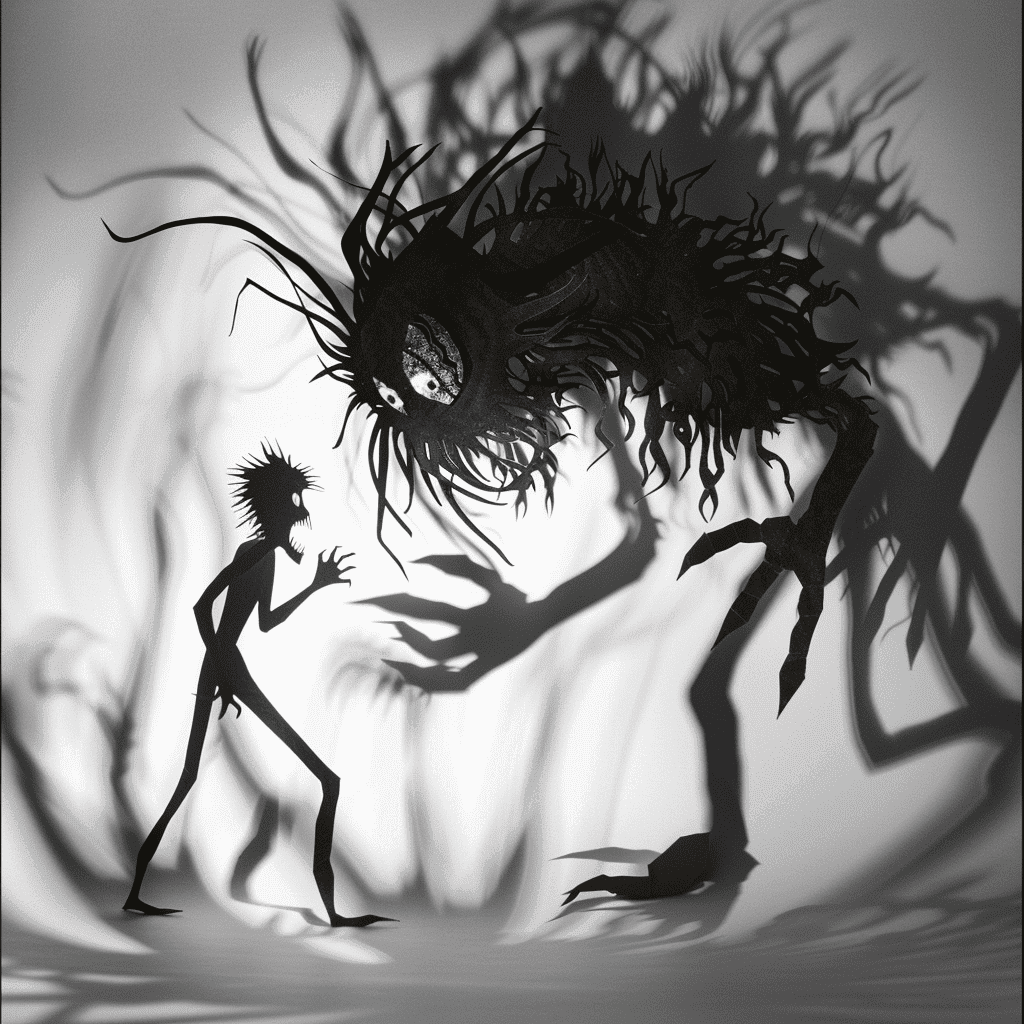
Dreams and the Unconscious (Water)
Dreams are, as Sigmund Freud put it, the Royal Road to the unconscious – the most direct path to access what’s really going on ‘under the hood’. Almost everything that happens in our mind takes place down there, out of conscious awareness, influencing our thoughts, feelings, and behaviours in ways that we know nothing about. Research suggests that the unconscious mind accounts for a massive 95% of all mental activity. Who we think we are is only a tiny fraction of who we really are.
Almost all our decisions are made before we’re aware that we’ve made them, by a part of the mind that we have almost no communication with. The unconscious is another realm with its own rules, its own language, its own goals and fears, and it has almost total control over us. That’s the bad news.
But the good news? Every night, it sends up messages.
What is the unconscious?
Before we look at these messages in detail, and how we can begin to learn the language they’re written in (spoiler – your dream language is unique to you, there is no dictionary) we’ll try to answer some questions about the unconscious – what is it? How do we know? Why should we care? Can’t we just leave it alone?
Most of us have an intuitive feel that we have an unconscious (it shows up as our conscience, or gut feeling, or through art, music, and dreams etc) and it’s been well documented that creative inspiration often seems to come from some uncharted part of the psyche, and that’s true in music, art, science, maths – any field that requires creative and intuitive thought. But don’t just take my word for it:
“I don’t know how I got to write those songs. Those early songs were almost magically written. … Try to sit down and write something like that. There’s a magic to it, and I don’t know where it comes from. It’s like it comes from some other place. … I can’t do that anymore.”
– Bob Dylan 1
“When I am in my painting, I’m not aware of what I’m doing. It is only after a sort of ‘get acquainted’ period that I see what I have been about.”
– Jackson Pollock 2
“The ideas just come to me; I don’t know from where. It’s not a conscious process but a kind of feeling that this is the right way.”
– Paul Dirac 3
“While asleep, I had an unusual experience. There was a red screen formed by flowing blood, as it were. I was observing it. Suddenly a hand began to write on the screen. I became all attention. That hand wrote a number of elliptic integrals.”
– Srinivasa Ramanujan 4
Some of the most compelling research on the unconscious was carried out in the 1960s by Arthur Reber, a cognitive psychologist. He used ‘grammar strings’ – lines of letters that appeared random but which nonetheless adhered to some complex pattern. Reber showed these strings to participants, who were asked to focus on them for a few minutes, but not try to decode them (which would have been impossible due to the complexity of the pattern). He then showed them new strings, some of which adhered to the pattern, and some which did not. Although the participants had no conscious idea of the pattern itself, they were able to say which strings followed the pattern and which did not, far more often than chance would allow for. Clearly, some part of the mind had learned something about the pattern, but not enough to make it into consciousness. Reber called this implicit learning – knowledge gained without awareness of what the knowledge is, or how it was gained. It is a key contributor to what Jung called intuition – that which we know without knowing how we know, and shows that the mind is able to learn and make judgements and decisions entirely unconsciously.
Other research has shown that:
Decisions are made in the brain before we are conscious of them, previous experiences affect how we feel about unrelated things, even when we’re unaware of the previous experience, and we learn patterns and respond to them without any awareness that the pattern exists.
This all points to a world of mental processing taking place entirely separate from our conscious idea of “myself”, and this world is the bulk of the mental iceberg. It shows that we detect patterns in the world without knowing, we’re affected by experiences without knowing, and we then make decisions based on those patterns and experiences without any conscious control.
So why should we care about our dreams? Because it’s the only communication we have from this other world! And as it makes up approx. 95% of our mental universe, I’ll let you decide whether or not there’s any value to be had in reading those communications. But it brings up another question – why is our mind structured in this way at all? What is the value of keeping almost everything hidden? Why doesn’t my Self trust myself?
What’s the unconscious for?
Dr Iain McGilchrist proposes an answer to this. In The Matter With Things he suggests that all animals have evolved to solve a puzzle – “How do I eat without getting eaten?” This is the fundamental problem of life, and it is two-fold. To solve it, we have evolved a split brain, comprising of a left hemisphere that deals with “how do I eat” and a right hemisphere that is responsible for “without getting eaten”.
The left hemisphere’s main job is to sort out the chaos and noise of the world into discrete, known objects – it takes the ever shifting mass of colours, shapes, sounds and smells, and sorts them into categories of things like cars and trees and people and food. Primarily it evolved to sort food-type-things from non-food-type-things, and this gave us power over the world. The more categories of thing we can identify, the more nuanced our understanding of our environment, and the more power we have over it. The left hemisphere needs precision, so it can tell the difference between an edible mushroom and a poisonous one. Its analytical way of being is very closely aligned with consciousness. But it comes at a cost! More categories means more processing time, and if we overload ourselves with discerning this type of tree from that, seeing the uniqueness of every little thing, we lose the ability to react quickly, and that puts us in danger of becoming prey ourselves. We don’t, for example, need to discern the exact species of snake when we encounter one, we don’t need to pay attention to its markings, we just need to react – SNAKE! MOVE AWAY!
In fact, we don’t even need to tell that it’s a snake at all. We need a second thinking system – the right hemisphere – that can react quickly, understanding that all unexpected animal-type-things are “DANGER”, whether they’re snakes, bears, or harmless puppy dogs (better to be safe than sorry). It is less bothered with what things are than with what they might be. It works with imagination, not analysis, (with Water, not Air) and in doing so it alerts us to all manner of predators and threats, no matter what form they take or how well disguised they are. It is the broad overseer, ever vigilant, it deals with uncertainty and confusion. It has evolved to see things that are half-hidden, and then to fill in the blanks with imagination, prediction, and guesswork. It is the influence of the right hemisphere that gives our dreams their symbolic, uncertain nature, and why their messages always seem so vague and unclear – the language of the unconscious is not concrete and objective (that’s the language of the left hemisphere), it is imaginative, vague, symbolic and suggestive. It’s how we manage to intuitively navigate a very uncertain world, it’s how we can tell someone is “a bit off today” or this situation “just doesn’t feel right”. It is also why our dreams are vague, symbolic, and full of strange associations – they arise during sleep, when the left hemisphere is least active and the right can come alive.
McGilchrist might say that dreams are the right hemisphere’s way of speaking to us, using images and metaphors to convey truths that cannot be reduced to words.
And knowing this gives us a way to interpret them.
How to work with dreams
There is no way to objectively analyse dreams. Each dreamer dreams in their own language, and this language evolves as we become fluent in it. What follows is a guide to working with your own dreams, a way to analyse them and extract some meaning from them. The messages that your unconscious sends up every night come in symbolic form, as this is the language of the unconscious, so at first they may seem baffling, random, and nonsensical. But once the unconscious realises that its messages are being heard, it will often send them up more frequently, and repeat the symbols that it knows you understand. In this way, the conscious and unconscious minds create a shared language over time.
The following guide is based on Carl Jung’s approach to working with dreams (for more detailed information I would recommend his book “Dreams” or, for an easier read, Inner Work by Robert A. Johnson is excellent.) No guide can ever tell you if you have the ‘correct’ interpretation, but with practice you’ll be able to feel for yourself whether you’ve found the mark. The only thing that really matters is – “Does this interpretation help me?”
Step 1 – keep a dream journal
Keep a notebook and pen next to your bed, and make it a nice notebook – one that you really want to write in, and be prepared to make notes in the middle of the night when you’re barely awake, and really want to go back to sleep. You’ll thank yourself in the morning. You might need a small torch if you have someone sleeping next to you.
When you wake up and realise that you’ve had a dream, write down every detail no matter how small. Your mind has crafted this dream and left out almost all of the detail, so whatever detail remains is there for a reason. If you dream of a red house, it’s red for a reason. If someone is wearing a hat, the hat means something. Even if you think “I can’t remember anything” or “It was just nonsense” write it down. More detail and meaning will come back to you as you write. Writing the dream in the present tense can help to put you back there, so try “I am in my childhood home” rather than “I was in my childhood home” and write down everything you can remember.
Step 2 – list the dream objects
Make a list (write it down) of every Object in your dream. An ‘Object’ is any major element, or anything that seems significant. So this can be physical things (people, animals, buildings) but also places, times, emotions – whatever the building blocks of the dream are. Not all Objects will seem relevant at first, but remember that there are far more empty spaces than Objects – any Object you can remember has been placed there deliberately, and for a purpose.
Let’s work with an example – this is a dream I had some years ago when I was training to become a therapist. I wrote in my journal at the time,
“I am with my older brother, standing next to my car. We are approached by a dishevelled man holding a sign that reads “Please help – I can not speak but need a lift to the University”. I am a little scared, but want to help, so I invite him to get into the car. before driving off I say “I’m scared you’re going to rob me, do you mind if my brother takes a photo of your face for our security?” He nods in agreement, so off we go. We drive for a while and I suddenly realise I am taking him in the wrong direction. He was close to the university when I picked him up, now he is even further away. I have taken him toward my destination, but not his.”
The Objects I wrote down for this dream were:
Older brother
My car
Dishevelled man
Sign
University
Destination
Step 3 – dream associations
Once you have listed all the Objects for the whole dream, make a separate list of all the associated feelings, qualities, values, memories you have for each Object. For this step it’s important to let go of the analysing part of the mind – don’t think! Don’t rationalise! Just be playful and see what comes up. What does this word mean to you? What does it remind you of? What other words, images or feelings pop into your head when you focus on this word? Don’t worry about if it fits with the context of the dream, that comes later. For now just list anything that comes to mind.
My list was:
Older brother – maturity, sensible, financial stability, safety.
Car – journey, power, control, old banger.
Dishevelled man – beggar, poor, needs help, unrealised potential.
Sign – communication, blunt, black and white, one-way.
University – knowledge, understanding, big ideas, becoming, excellence, arriving.
Destination – goal, staging post, aim, direction.
The associations don’t have to fit together, they don’t have to make any sense, just allow the Watery part of your mind to take the lead on this step – let the unconscious lead, and write down whatever comes up. Many of the associations won’t ring true and can be discarded later, that’s fine.
Step 4 – relate it to your life
Once you have the Objects with their associations, how do these associations relate to you, right now? Is there any part of you or your life that might be represented by this association? Allow the Airy part of your mind to have a say here – let it think and analyse and make sense of the associations, but don’t let it take control.
I related the Associations to my life in the following way:
The Car – this related to my own sense of power and control in my life, and whether I was using that power to adequately control my life journey.
The University – this related to my own sense of who I wanted to become, where I wanted my life journey to lead, and the big ideas I had that I wanted to explore.
One school of thought is that every person in your dream is actually a part of your own psyche. So the Older Brother in my dream related to the part of me that is mature, sensible, and seeks the safety that comes from financial stability. The Disheveled Man on the other hand related to the part of me that I had largely ignored, but had unrealised potential in some way that could be brought to fruition with some help.
Carry on in this way, matching the Object associations to aspects of your life right now. Be honest with yourself, and remember that dream images come from your unconscious, from the part of you that you don’t know, and possibly don’t want to know. The point of this practice is to know yourself more fully, and for that you need to shine a light in the shadowy parts of your mind – that’s where the hidden self-knowledge is.
So we have our dream, we have listed the Objects that make it up, we have listed their associations and related them to our current life in some way. How can we tell though when we’ve hit on the correct interpretation? For that you’ll need to listen out for…
Ste 5 – the Ring of Truth
…the Ring of Truth. You’ll know it when you feel it. There will be a small surge of energy in you, something will go ‘click’, and you’ll know that the bell of truth is ringing. Again, don’t think too much, don’t try to force it, just let things emerge. Explore, be playful, and wait until something tells you “Yes. That is the correct meaning of this dream object”. This won’t come from the rational, analytical part of your mind, but from the intuitive part. You’ll know it’s true without knowing how you know. Remember – the unconscious is trying to tell you something about yourself and your situation. It wants to be understood, but the conscious mind may try to reject it, in order to keep your current self-image intact. The Bell of Truth doesn’t always ring right away (Jung reported several dreams that didn’t make any sense to him until years later) but the more you practice this exercise, the clearer you’ll hear it when it does ring.
Step 6 – The Dream Interpretation
Now you have all the objects, the bell of truth has told you what they represent, you have applied these meanings to parts of your own psyche or life, now you can put them together into a narrative, and extract the meaning. Again, the ring of truth will be your guide. What message can you get from all of this? The interpretation I got from my dream was the following:
There was a part of me that wanted to become a therapist in order to learn ‘the language’ needed to understand and communicate ideas about myself, the world, and how it all fits together. That’s The Dishevelled Man wanting to get to the University, the place of Big Ideas. But he couldn’t really communicate his reasons ‘why’ to the rest of me – I hadn’t allowed him to have a voice, and he didn’t understand his ideas yet either. I didn’t really understand what was drawing me to study therapy, or ask big questions about life, I just knew I was drawn to it and that I should pursue it. The Older Brother was the part of me that was asking “yes but can you make a living from it? Is it a sensible idea or just a pipe-dream?” and both he and I were worried that the Dishevelled Man would “rob us” of a different future, perhaps a more traditional one. We were scared that he might take us off-track, on a wild goose chase. So taking a photo of his face represented a desire for security, for accountability, to be able to explain to people how it all went wrong, if it did go wrong.
As it happened, I ended up robbing The Dishevelled Man of his destination by “taking him in the wrong direction” which I interpreted as concentrating too hard on my day job at the time and not prioritising enough time to study the things that I felt were really important (like dream analysis!).
So the message of the dream was something like:
Financial stability is important, so don’t be reckless, but you need to realise your untapped potential and focus right now on pursuing your own ideas and interests.
My unconscious was telling me that my life was out of balance (too much focus on security, not enough on growth and learning) and how to address this (spend more time reading and studying – it will lead to financial security in the end). It wasn’t a life-changing discovery, the dream didn’t really tell me anything I didn’t already know, but it gave me encouragement to follow that path, and put more resources into it. This is how it often is with dreams – when you hit upon the correct interpretation you realise that you knew it all along, but some part of you had been pushing it out of awareness. You had been resisting the truth of your situation.
We all have the ability to deceive ourselves, and one way or another we’re doing it all the time – it’s a vital skill in fact, as if we were truly conscious of all that life is, every danger, every possibility, every opportunity, it would overwhelm us. Reality in it’s pure, raw form, is a chaos of ever-changing sensory data and events. The purpose of the conscious mind is to restrict this infinite soup into something manageable, that we can manipulate and navigate in small ways to achieve modest survival goals. Consciousness keeps us on a safe path toward a specified goal. Dreams are a glimpse into the other side – not just survival, but growth and transformation. Sometimes they are a suggestion, other times they are a warning. But they always tell you some true thing about yourself that will aid you in your journey toward self-actualisation, if you can find the courage and the patience to listen.
Now get yourself a notebook, and invite your unconscious in.
“The gold is sought in the depths, in the darkness of the earth, where no one dares to go; yet it is there that the treasure lies.”
– C.G. Jung
Quotes:
1 – Bob Dylan speaking to 60 Minutes in 2004
2 – Jackson Pollock talking to Possibilities magazine in 1956
3 – Paul Dirac in The Strangest Man by Graham Farmelo
4 – Srinivasa Ramanujan in “The Man Who Knew Infinity” by Robert Kanigel