
Clarity (Air)
We are all explorers here, thrown into this strange world as infants and left with no real guide as to what we should be doing or how we should go about doing it. We have our parents, teachers, celebrities, religious figures, and all manner of other role models, but they don’t often guide us with a single voice. There is little consensus in the world. It is very difficult for a child to live with much certainty, and as the child matures into an adult and develops the capacity for self-leadership, those guiding voices often sound less and less trustworthy.
We’re left with more questions than answers – what should I value? What should I seek? How should I spend my time, my resources, my energies?
These questions can stay with us for life, as the possibilities seem almost endless. How can we sort out that which is valuable from that which is not? Thankfully our minds are capable of giving us maps to follow. Frameworks of understanding that can guide our choices. But to do so we must be willing and able to see the maps, and to read them with clarity.
Clarity – the ability to see things clearly, and the willingness to accept them as they are, not as we would like them to be.
It sounds so simple! But seeing things clearly is just not what our brains have evolved to do. The problem with seeing things clearly is, there are just far too many things to see, and almost all of them are completely irrelevant. Each time you’re looking at a tree, you’re actually looking at thousands of leaves, branches, twigs, fruits, each one different and unique. Each branch is covered in hundreds of different shapes of moss and lichen, each leaf contains a unique pattern of intricate veins. No two trees are the same. And how many trees do you walk past each day? How many pigeons, or dogs, or houses, or pieces of litter? The world is a giant three-dimensional collage of unique details, far too numerous for our brains to pay attention to, and analyse, every moment.
So rather than analyse, we categorise. Gestalt Psychology explains how your brain makes very quick decisions about the mass of shapes and colours it encounters and lumps them together into discrete objects and groups. (Or see this from cognitive scientist John Vervaeke on what he calls Relevance Realisation). Your brain says something like, “That mass of thousands of things is actually a single thing, a tree, and that mass of individual trees is a single forest, and the impossibly complex world around you becomes manageably simple.
What we perceive is not just what we see. Perception is the relationship between what is ‘out there’ (raw objective reality) and our own expectations ‘in here’ (our subjective lenses and experiences).
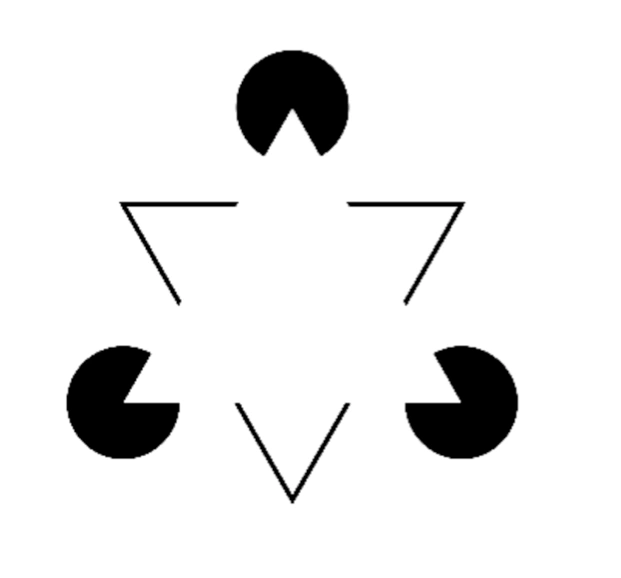
See for example this triangle that doesn’t exist…
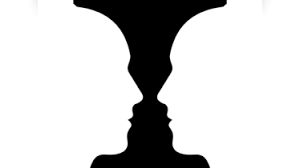
Or this vase that isn’t there:
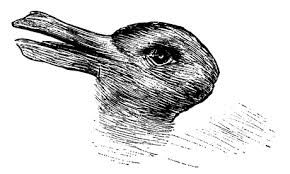
Or this duck that’s also a rabbit:
By using this method of fast categorisation, and filling in the blanks, we can navigate our environment, keep ourselves safe and alive, and work toward our goals, whatever they may be in any given moment. Right now, your brain is focusing only on the words you are reading, while ignoring almost every other thing around you. If we were to experience the world as it really is, clearly, without our brain imposing any filtering or categorization, we would probably experience a psychedelic kaleidoscope of colour, sound, texture, sensation, and it would overwhelm us. How could we walk through a field of grass when paying attention to the millions of individual tiny green structures, dancing in the wind? How would we ever find the other side?
So if Clarity is seeing the world as it really is, then it’s no good to us. That sort of clarity would not be helpful. Instead, we need to understand that our brains do something even better for us – they create a sort of three-dimensional map, leaving out almost all of the detail, but leaving in just enough so that we can navigate through it without getting eaten by predators or succumbing to other dangers. Our brains simplify complex reality into a low-res, easily understandable working model. Very quick, very effective, very useful, very safe.
But with the potential to be wildly misleading. As Alfred Korzybski famously said,
“The map is not the territory”.
Map Making
Imagine you are in London, and you want to get to Manchester. What sort of map would you need? A road map would be useful, but only if going by car. A London Underground map might be essential. If you’re planning on hiking there, then a map of footpaths and campsites might be better. But a map of the London sewerage network, even if extremely accurate and detailed, would likely be of no use whatsoever. The type of map you need depends on two things:
1 – An honest (but incomplete) depiction of the territory. It needs objective validity.
2 – An accurate understanding of where you’re trying to get to or find. (Your personal goals and context). It needs subjective validity.
A map is only useful if it is both true, and relevant. And this is how we will define Clarity – it is seeing the world in a way that is objectively true, and also personally relevant.
So where do our maps come from? Do we have one map, or several? Do we make them or find them? Can we use other people’s maps? Difficult questions to answer, and likely highly individual. Some people may live successful, passionate, meaningful lives with only a single map that was passed on to them (those who follow a religion, or a cause, or a family path, for example). Others need to create their own map by throwing away the maps that were given to them (by parents, or school, or religion, or experience) and head into the wilderness of possibility. Let me suggest two qualities that our ideal map should have, and we’ll call it the Dynamic Integrated Map.
The Dynamic Map
Our map should be Dynamic because it is capable of change, it can be updated as new information becomes available, goals change, old information becomes obsolete. Think of Google Maps’ ability to reroute you depending on the changing traffic conditions and road closures. This is far superior to a paper map. Our own map must be capable of the same! An example might be starting a new job. At first the map is empty, it’s your first day and you don’t know how things work or who to watch out for. You don’t know where the threats and the opportunities are. In this situation the map requires you to move slowly and carefully, while you uncover the relationship dynamics in the workplace, map out the routines, fill in the empty space with an understanding of how things work. Perhaps you’re still working from old maps – a map from your last workplace, or from childhood. These may give some limited true information (perhaps you act as though your new boss is your parent, and your colleagues are your siblings?) and this may keep you somewhat safe (respectful of authority, playful but cooperative with equals) but at some point you may find that treating your boss as though they are the stern authority figure you must never talk back to, or the understanding safety net that could solve all your problems (or however you experienced your own parent) is obsolete information. Your map needs updating! Your boss is sick of your bullshit now and the map which initially helped you appear respectful and cooperative is now making you seem like a child, incapable of speaking truth or solving your own problems!
A Dynamic map must be capable of change. It must update itself in real time, and accept that each person, each situation, each relationship is different, and be willing to reroute you based upon each interaction you have with the world. It must guide you towards ever-increasing alignment with the world as it is now, not the world as it was then.
To do this, we need Honesty. We must be willing to speak truth, no matter how uncomfortable it may feel, or how many years of diligent map-making need to be thrown out in order to incorporate new understandings about ourselves and the world. Real world maps do it all the time – national borders change or disappear, coastlines fall in the sea, new passages open in the arctic sea ice, new roads are built and old bridges swept away. A dishonest map is a dangerous map! Your boss is not your mother. Your colleague is not your brother. Your wife is not your ex-girlfriend, or your sister, or your primary school teacher. The cherished belief that has formed part of your identity for years, may not feel right any more in light of new information. The world is changing and shifting around you all the time, it is only through Honesty (both with others and with ourselves) that we can accurately create the dynamic map that we need.
The Integrated Map
As well as being dynamic, our map should be Integrated because it contains information from many maps, allowing you to utilise the information that is relevant to you, which will change throughout the day. When I wake I may need to consult my Health Map to decide what to eat for breakfast, whether to go to the gym or rest, whether I need a coffee stimulant or not. Then I will need my Professional Map to help me navigate the workday – am I performing well, and what are my opportunities for growth? Later I will need my Relationship Map so I can enjoy time with friends and family, nurturing relationships and avoiding threats which may lead to disconnection. But these maps work best when integrated – how does my health affect my work? How does my work schedule affect my relationships? How do my relationships affect my health? By integrating maps I hope to avoid the danger of putting all my energy into just one path. The workaholic over-achiever does this, as does the anxious lover and the fitness obsessive. Living a life according to just a single, unintegrated map can lead to a life out of balance.
We need Perspective – the ability to understand things from different viewpoints. An example might be my Health Map telling me that going to the gym is good. But my Work Map may tell me that it will exhaust me, leaving me less sharp in the afternoon. My Relationship Map may tell me that time spent in the gym is time spent away from my partner who already feels ignored, and my Adventure Map may ask just why the hell I’m spending all this time on my legs if I’m never going to actually hike up a mountain.
An Integrated Map can draw on all these viewpoints, and seek out a balanced perspective. While going to the gym may well be healthy for my body, it may be less healthy for my relationships or career. Or perhaps the opposite is true! Perhaps I need the gym to increase my vitality so I am sharper at work and more energized in my relationships. The point is that I can’t truly know if I am only working from a single map. Only by integrating many maps can I hope to find balance in life, and make the alterations necessary.
The Dynamic Integrated Map
But Honesty is dangerous without Perspective (that way zealotry lies), and Perspective is useless without Honesty (that way cowardice lies). Clarity is the ability to wield both – to be honest about what is and is not, but to do so with perspective – an understanding that different people have different values and different goals. What is a valuable resource for you may be a trap for another, and vice versa.
The Dynamic Map allows space for honesty, as it allows change.
The Integrated Map allows space for perspective, as it draws on different maps.
The Dynamic Integrated Map is both of these – honesty and perspective. Firmness and fluidity. Objective and subjective. It tells us both what is true, and what is relevant. We must be capable of accepting the world the way it is (not the way we wish it to be) whilst also knowing what matters and what doesn’t.
Above all, we must have the courage to speak truthfully (on both an individual subjective level and also a general objective level) and then act in accordance with it.
Honesty, Perspective, then the Courage to act.
This is living with Clarity.

